
This page answers two questions. Who is the person writing this, and what is Plastic Human for. The first one is a story. The second one is the reason the story is here.
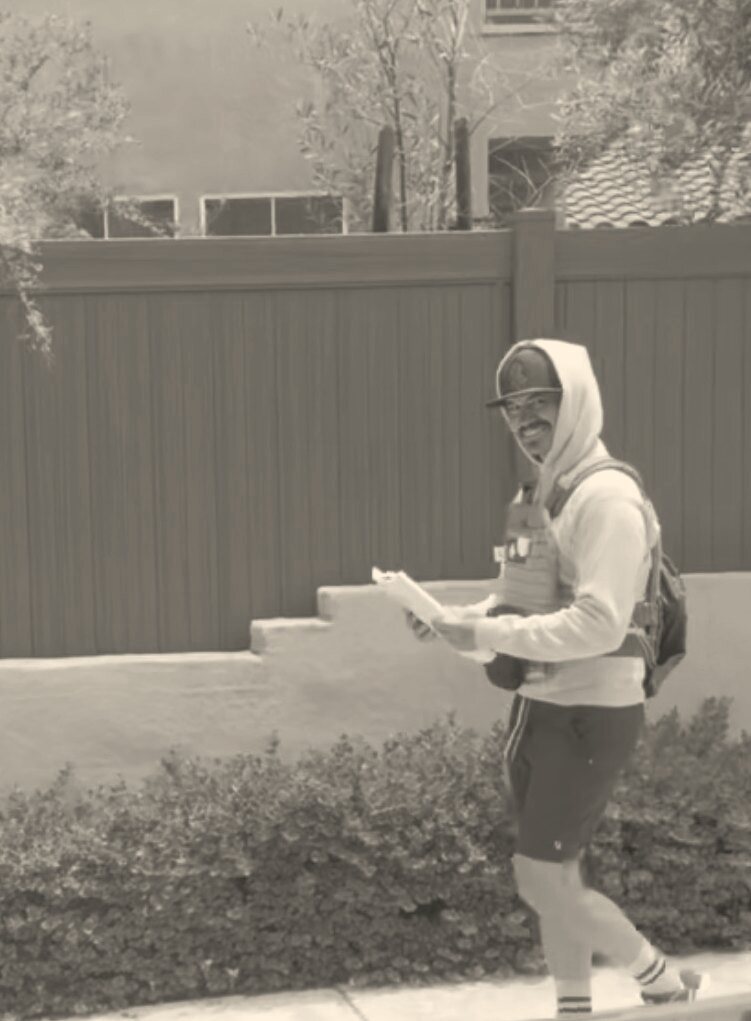
Before it was a philosophy, it was a boy in a guest room deciding he did not have to stay the person he had been.
New Year's Eve in Peru. Twelve years old, seventh grade. His parents left for a party and the panic came the way it always came: the nausea, the spiral, the certainty that he could not be left alone. He had run from the sixth grade camp bus that spring, two miles from the campus, hiding in a bush until he saw the bus had left. He was the kid who called his mom to get picked up from sleepovers at ten at night. This was who he was. Everyone understood that.
Sitting alone in his grandparents' guest room, in tears, he had a conversation with himself that changed everything after it.
You don't have to be this. You're choosing this. And if you're choosing it, you can choose something else.
Peru · age 12
A warmth started in his gut and spread upward, like a fire lit from the inside. Not power over anyone else. Power over himself. He told himself two words: never again.
It would be easy to say he walked out of that room a different person and never felt anxiety again. The truth is, he did not. There continued to be sad days and nervous days after it, plenty of them. The anxiety continues to this day. It shows up in different places now, and for different reasons. He does not pretend otherwise. What he got in that room was not a cure for unease. It was something better: anxiety is a signal. He walked out armed with the knowledge that when there is something about your life you want different, a better version exists, and you are the one who has to choose it and have the courage to move toward it on purpose. He has learned since that anxiety has a why. Find it, and the fear stops being noise and becomes one more element that shapes the mountain.
People can change. He has spent every year since proving it.
That is the first thing you should know about the person writing this: the philosophy on this site was not read in a book and repackaged. It was lived first, and for a long time, before it had a name.
His career started as a file clerk in his father's firm at fifteen, in a room holding over one hundred thousand paper files. A sponsored surfer at eighteen, top fifteen in the country. He was not the prodigy; kids he competed against went on to become the best in the world. But there was a career there, a real chance to make a living as a surfer, laid out in front of him, and he knew it was not the road he wanted to walk.

At twenty-two he sat in his parents' courtyard after a flat day at the beach, half drunk, and asked himself whether this was the whole of what this "pro surfer" life was going to give him. Then he called his father in Peru and asked for a chance to take over the family firm. Not "I'm done surfing," but "I want in." The answer came with a condition: come to work for me full time, finish your degree at night, get into law school and graduate, and the final condition: the only way you take over the firm is to pass the bar. He hung up and started calling sponsors to let them know he was hanging up the wetsuit.
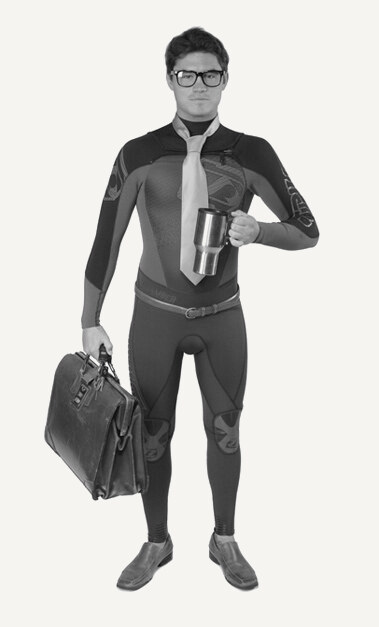
Then the chapters that looked like detours and were not. He grew the collections firm from two hundred thousand dollars a month to seven hundred thousand, built a team of 40 people to a team of 135, finished a degree and law school while working full time, and learned the ins and outs of business operations running a team that serviced Fortune 100 banks, overseeing everything from Human Resources to Business Development to Information Technology and software development. Then the regulations that followed the financial crisis hit the industry, and he oversaw the staff reduction himself. He personally laid off more than 65 people. The hard seasons did not end there. Shortly after he finished law school, he and his father sat down and agreed that the pie was not big enough to feed them both, and that he would leave the firm. With his future unclear, he took a job in construction and studied for the California bar. He passed on the first try, and found out when he logged on in the warehouse after getting back with the crew to unload the tools. He had to leave the room in tears, because the moments that confirm you are who you thought you were do not wait for a convenient time to show up.
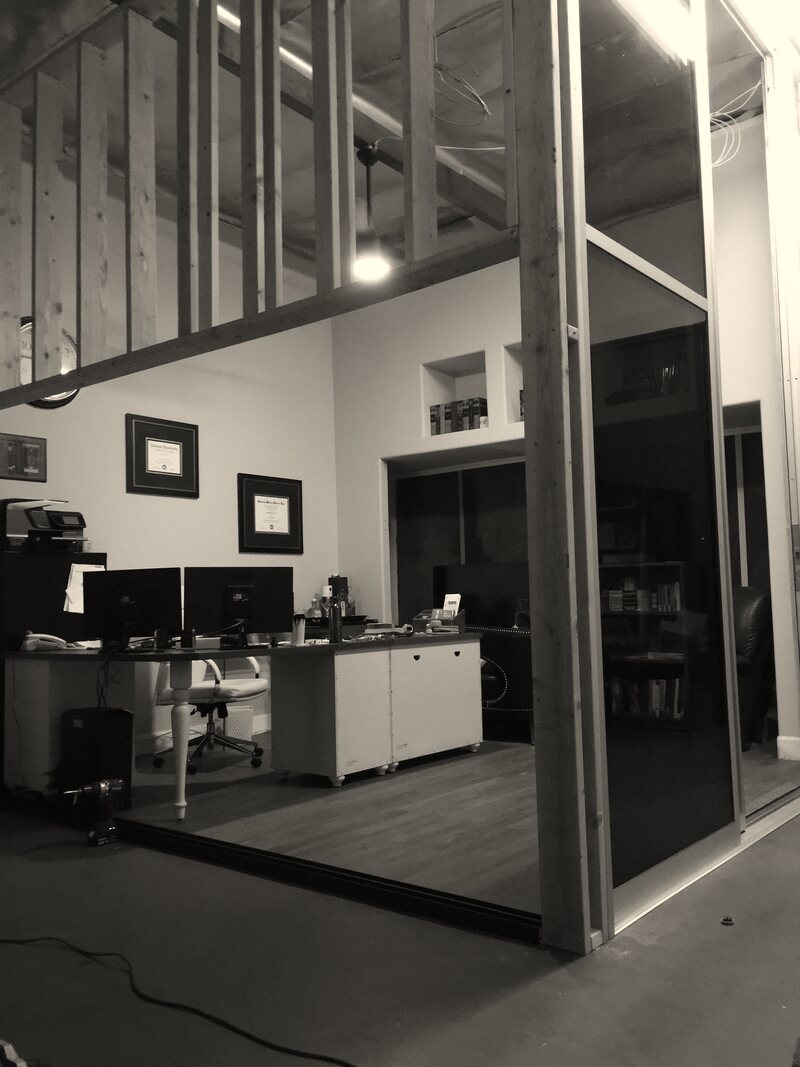
So he built an office inside the construction warehouse and started his own firm. He kept the construction job, helping a friend run his business, driving to job sites, learning the business from the inside so he could help his friend grow it. Then back to the warehouse to field calls and try to grow a law practice from a desk between the tools. The friend later became his partner in a windows and doors company. The habit of learning a business from the inside before touching it became the way he advises his clients.
Over the same years he partnered with entrepreneurs to build businesses in a variety of industries: cosmetology and barbering, consumer goods, construction, software, marketing and sales, consulting, and his own legal practice. Some of them ended, some of them are still thriving today. Alongside them he walked hand in hand with clients in consumer goods, restaurants, construction, professional services, and a dozen other industries, inside their operations rather than across a desk.
And when his parents' firm, the one he had asked for at twenty-two, faced serious operational problems and was on the verge of failure, he walked in as a consultant, opened the books, and did not leave for eighteen months. His father was no longer himself, and no one yet knew why. Jordan, newly his wife and pregnant, carried the home and carried him. He saved the firm from ruin and put it back on a growth trajectory. Then came the part no one expected: his parents offered to fold his firm into theirs and hand him the thing he had wanted since the courtyard. He held his newborn daughter, looked at the partnership agreement he was drafting on his own desk, and what was not there was the loudest thing in the room. The fire he felt at twelve, the one he had learned to listen to for more than twenty years, was not there. This was not what he was called to do. He said no. The firm closed on its own terms. His father, he came to understand, had never been raising an heir. He had been raising a free man.
Today he is an entrepreneur, a consultant, a business and employment lawyer, the operations and technology half of an SEO agency he built with Jordan, an investor and partner in multiple ventures, and a builder of systems to help people grow in their lives, their businesses and their dreams. Different industries. Different decades. One instinct: systems in service of people. Every chapter was building a capability the next one needed, and every chapter is where the ideas on this site were tested before they were written down.
In 2026 he found a notebook from 2008. On a page dated September 11 of that year, written at twenty-two in a season that belongs to the Love task of life and not to this page, was this:
I'm a rock on a mountain,
The notebook · September 11, 2008
I am mobile with enough force.
I need to be firm, I need to be the mountain.
Leaves fly by, but I need to be strong.
Let the water and wind shape you.
But never let it move you.
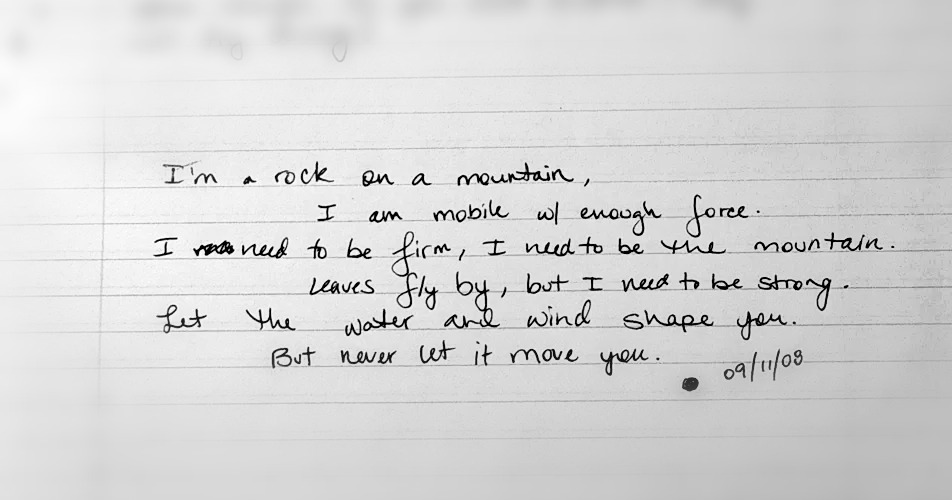
Read it again. It is not a description. It is an instruction, written in the first person by someone telling himself what to become. And it is honest about where he was: a rock, not yet a mountain, still movable with enough force. The man who writes this site is the one who kept the instruction. The mountain metaphor, in his own handwriting, eighteen years before this website.
In 2016 he recorded a voice note about helping people grow, eight years before he knew Alfred Adler's name. When he finally read Adler in 2024, the feeling was not discovery. It was recognition. He already believed people can change; a room in Peru had settled that. Neuroplasticity had shown him the brain rewires. Adler gave the frame: meaning is made through the tasks of life. Put together, a philosophy he had been living since he was twelve finally had language.
Plastic Human. Not plastic as in fake. Plastic as in moldable, adaptable, becoming, alive.
Plastic is the material. It took him until 2026 to say out loud that the mold has a caster. He believes God cast it. You may believe it was cast by your highest self, the person you would already be if fear had no vote. This philosophy does not ask you to settle that question. It asks you to fill the mold. The only faith this work requires is faith in yourself: that something greater already exists within you, and that you reach it by calling inward, not by searching outside. The heat and the pressure, the hard seasons, the tasks you did not choose, are not interruptions of the plan. They are how the material takes its shape. They are also the water and the wind.
Everyone starts as a grain of sand. Pushed and pulled by anything. A wave recedes and takes you with it.
With enough time you become a pebble, then a rock. More structure, but a bigger wave still moves you, and a river still carries you downstream. Then roots: a flower, a bush, a tree. Harder to uproot. But the tree still falls. Most people spend their whole lives here, swayed by every wind, moved or uprooted by whatever happens to them, reacting to circumstance.
Then the mountain. The elements do not move it. They shape it. Rivers run through it and leave scars. Earthquakes expose its edges, and that is its character. Hurricanes pass over it and it is still standing. Fires change its landscape and new life grows on it. The oldest structures on earth, forever altered by what happens to them, never changed in what they are.
The tree is moved by life. The mountain is shaped by it.
You do not become the mountain despite what life does to you. You become it because of what life does to you. The scars are not the end of the story. They are the character carved into the rock.
And a mountain is never alone. Your spouse, your children, your family, your community: each of them their own mountain, the valley between them what makes each one distinct, and together a range. An abundant place. A shelter. Somewhere other things can root and grow. The goal was never to be the mountain alone. It is to help the people around you become the mountain too.
One sentence, the same one he recorded in 2016: to help people grow. In the language of this site, to help people become the mountain, and then help the people around them become it too.
Not to motivate you. Motivation fueled by anger or insecurity does not last and he is not selling it. The work here is quieter and harder. It starts with the Self, because everything else is built on it: finding the signal that tells you what you are actually here to do, interrogating the stories you were told and the stories you were sold, and taking courageous, consistent action in the three tasks every life has to answer. Occupation, how you work. Community, how you contribute and connect. Love, how you love and are loved. The Self is the mountain. The three tasks are how the mountain stands against the elements and persists.
This site is not meant to hand you an answer to the meaning of life. That is yours to answer through your actions. The traits you build are yours to name. The mold is yours to fill. What Plastic Human offers is the questions that guide you toward your own answers, a framework to use as a tool on the journey, a record of someone who has used it under real pressure, and a companion on the road he calls Self Wealth.
He is a husband to Jordan, a father to Luna, Rhone, and Walker, a lawyer, an operator, and a builder. He is a student of life, on a journey of becoming the mountain. He is a Plastic Human. The philosophy is not separate from any of it. It is how he shows up in all of it, including the parts that are not going well. He is building things right now that he does not know how to build, doubting himself at every corner, and doing it anyway. Doing what you are called to do does not mean it is easy. The fear lives there too. The water and the wind do not stop.
At home there is a typewriter with his daughters' initials on it and flowers for their middle names. He uses it to write them letters. The man who automates everything chose to write his most important words by hand. That is not a productivity decision. That is the philosophy.
I need to be a compass for my kids, not a bank.
Daily thoughts · 2022
His father walked down the hallway every morning and asked his three sons the same questions. Are you motivated? Are you energized? Are you sure of yourself? When everything is counted, the legacy Nico wants to leave is one sentence, and it began in that hallway: he was a good man.
That sentence is his. This site exists to help you find yours.
Read the Framework once, slowly. Then leave your email below so you hear when the essays go live. If you are an entrepreneur, a leader, or an operator with a practical problem in front of you, the Guides are built for exactly that.
Then walk with him. Let the water and the wind shape you. Become the mountain.
The site is being rebuilt to bring the future of Plastic Human to life. Leave your email and you will get updates as they come. Nothing else, no noise.